








The age of the site is not the key factor, and links are still important. Website promotion in Google – we understand what is important and works. In this article, you will learn the main factors of Google ranking for 2024 and how to promote your website on Google.
This material will be useful both for business owners who order SEO services and want to figure out how to promote their websites on Google, and for SEO specialists.
1. How to promote a website on Google
As of August 2024, 9 out of 10 Internet users (90.48%) use Google to search for information. That is why it is so important to adapt your resource to the requirements of this search engine.
You can get to the first pages of search results using different methods: paid and conditionally free, on your own or with the help of contractors. It is also important to allocate a budget and think about how to optimize it.
– How to promote a website on Google on your own
Many website owners take the first steps in promotion on their own. It may not be possible to break into the top for HF queries, but it is very realistic to lay the groundwork for future promotion.
For example, you can work out the structure of your website yourself. To do this, it is enough to determine the main search query for your business and study the top Google results for it. If the search engine has already recognized these sites as high-quality, you can safely focus on their “skeleton” and fill it with your own content.
This procedure seems simple, but it lays a solid foundation for the promotion of a young resource.
– How to promote a website with the help of an SEO specialist or team
There are at least 2 important reasons to contact SEO specialists to promote your website on Google:
- Experience and specialization.
- Distribution and parallel execution of tasks.
As a result, the time for promotion is reduced and the budget is rationally allocated. Positions, traffic, and return on investment are faster. You have to do everything sequentially, which means that it is slower.
– How to save money by promoting your website on Google?
You can and should optimize SEO budgets. Alternatively, you can take on some of the work yourself. For example, write content yourself. It takes time and requires knowledge and skills (SEO copywriting), but it saves money.
An important point to reduce costs is to plan SEO promotion at the start of the project. This way, developers will make the initial settings first and minimize improvements when launching SEO promotion.
You should also immediately hire an experienced SEO contractor, or better yet, a team. It will be more expensive in the moment, but the total amount will be less than in the case of non-professionals, after which dozens of man-hours of work will be required.
– Is it possible to promote a website on Google for free?
Let’s just say that it is difficult to reach the TOP 3.
However, it is necessary to use free promotion methods in your overall strategy. For example, posting links to your site on forums, message boards, or social networks costs nothing, but it significantly improves your link profile and drives targeted traffic.
2. What will prevent promotion on Google?
SEO promotion on Google is not a fast process in principle. But there are factors that can further slow it down:
- Domain age. Google is only taking a closer look at websites that are less than 1 year old.
- Low-quality pages in the index. No matter how much you work on improving conversion pages, the “garbage” pulls the entire domain down.
- Incorrect structure, incorrectly distributed semantics can complicate the interaction with the site for both users and search robots.
- A complicated process of editing pages. For example, if the site is not based on CMS.
- Focusing only on RF queries. It is cheaper and easier to get to the top of the SERPs for the HF and LF queries, at least in the first stages.
- “Gaps” in basic SEO (technical errors, weak content, etc.).
3. 26 main factors affecting Google rankings
According to a study from August 2019, based on 1584 opinions of SEO specialists, there are 26 key factors that we will consider in this article and figure out how to optimize a website for Google.
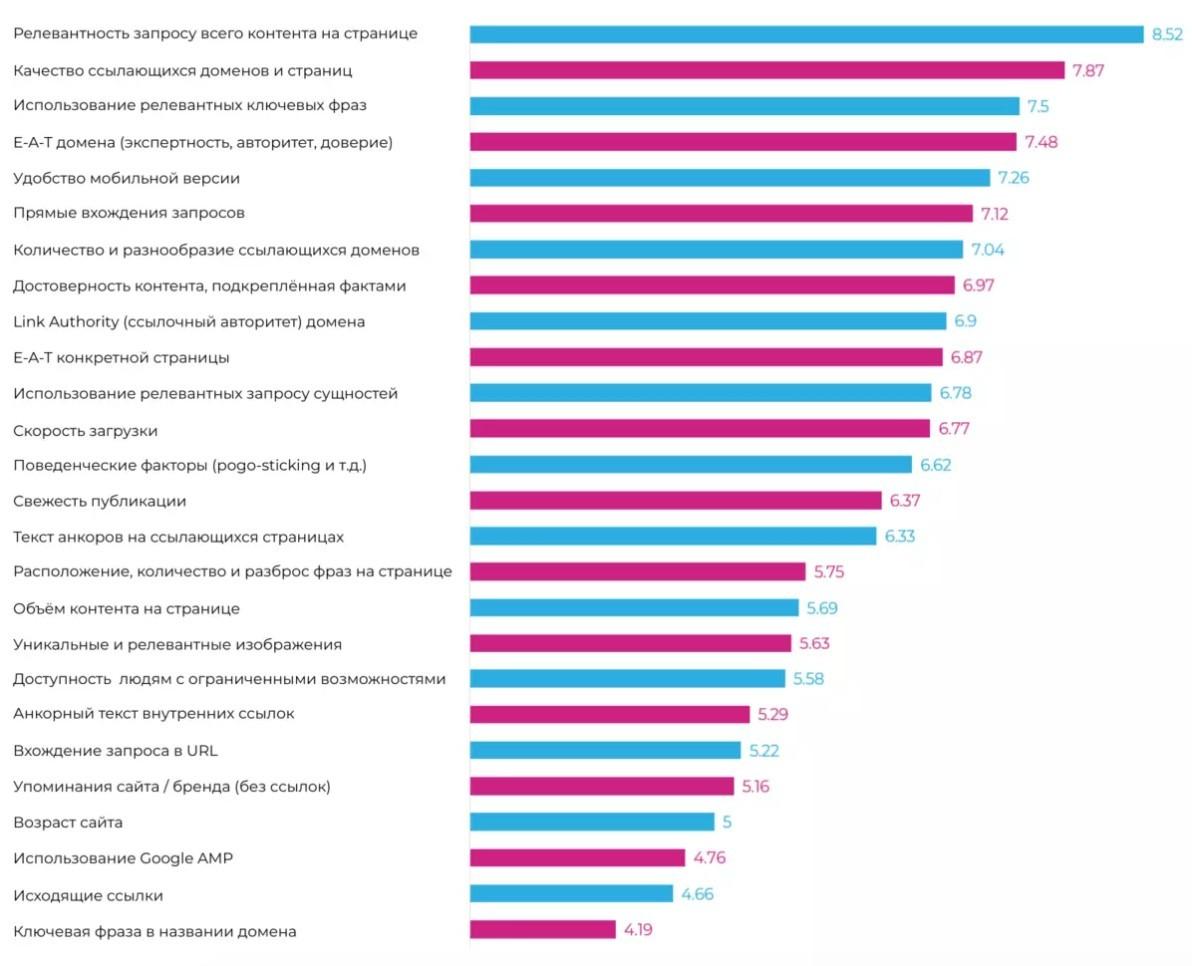
It is important to emphasize that more than 60% of SEO specialists believe that the weight of factors varies from query to query. That is, the combination of factor weights can be different for each individual search query.
– Query relevance of all content on the page
It is not only about the text, but also about other materials on the page. If it’s a listing card in an online store (product category), it means products and their short descriptions in the cards, auxiliary blocks. If it’s a service page or an informational article, it means photos, tables, videos, and other page content.
Google help states that the subject matter of a page is determined at the stage of its indexing:
Quote from the help:
“Once a page is discovered, you need to determine what topic its content is about. This process is called indexing.
It means that Google analyzes the content of the page and organizes the images and embedded videos found on it.”
Google takes into account the words (including synonyms) that are on the page, as well as the areas where they are placed.
Whether the language of the content matches the language of the query.
Quote from the help:
“The main indicator that the information on the page is important is the presence of the same keywords on it as in the search query.”
Useful information: how Google search works – help.
How to raise your website in Google search? Prepare content that reveals the topic and answers user questions.
– Quality of domains and linking pages
The number of low-quality link donors on the search engine marketing market is very high.
Moreover, over the past few years, crowd links (links from forums and comments) have been trending, which are often of low quality as well.
Thus, today the value of really high-quality donors has increased even more. Promotion on Google requires investment in project links.
– Use of relevant key phrases
Optimizing a website for Google is all about clear semantics. Important theses:
- The page should have clear semantics – a list of key phrases that are being promoted.
- Google loves precise usage. Use keywords to define the content and topic of the relevant page.
- The optimal keyword density in the text is no higher than 3%.
Make the right TOR for a copywriter, which should be based on the analysis of competitors in organic and take into account
- the volume of the text;
- key phrases that should be present;
- text structure;
- design (use lists, tables, etc.);
- words that define the topic;
- requirements for the density of key phrases.
– E-A-T domain (expertise, authority, trust)
EAT is an acronym for Expertise, Authority, and Trust.
The Google update in May 2019 changed the importance of E-A-T. Now it is one of the factors that determine the quality of a particular page:
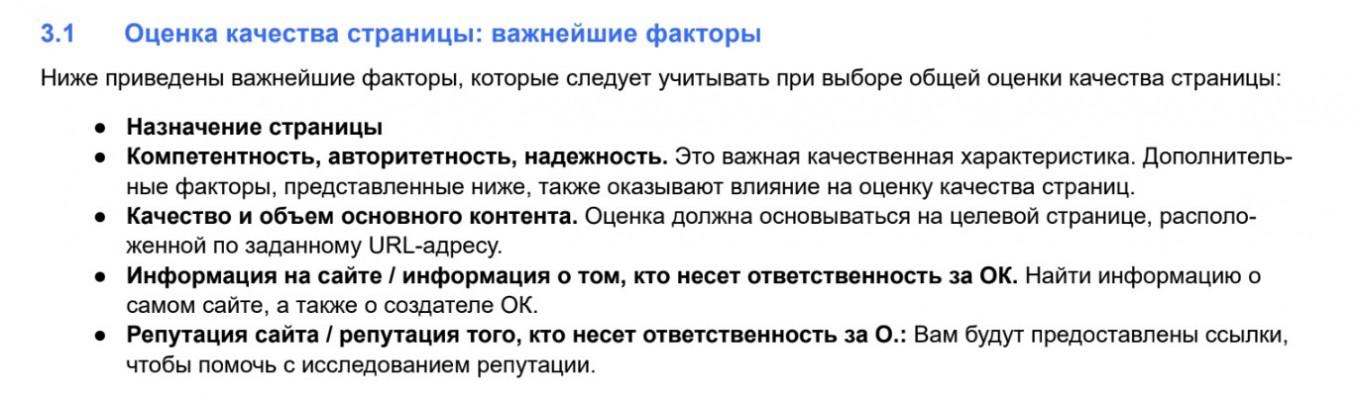
- Expertise. Is the content creator an expert in their field? Does he or she have an account on the site, is he or she mentioned on other sites?
- Credibility. It has to do with the content author, the content itself, and the website.
- Reliability. It has to do with the author of the content, the content itself, and the website.
Google’s E-A-T guidelines indicate that not all topics require a high level of expertise, authority, and reliability.
Some topics do not require a high level of competence. Many people write very detailed and useful product or restaurant reviews.
Many people share advice and life experiences on forums, blogs, etc. These ordinary people can be considered experts in areas where they have enough experience.
If it seems that a person has enough experience to be considered an expert in a given topic, we will appreciate it and will not “penalize” the person/website for not having formal education in this area.
The higher the overall E-A-T scores of a website, the greater its weight for Google.
– Convenience of the mobile version
In many commercial topics, the share of mobile traffic can exceed 50%.
It is necessary to constantly monitor the state of the mobile version or adaptive layout of the site.
Checklist for checking the mobile version of the site:
- The resource has a high loading speed.
- Access to JS, CSS, and graphic files is not closed for search robots.
- It is convenient for users to browse the pages.
- The code contains the viewport meta tag (for adaptive layout, for all pages).
- The rel=“alternate” tag is written (if the site has a mobile version on a subdomain).
- Correct redirection from the regular version to the mobile version.
- The Title and Description tags have been optimized.
- The content of the mobile version reflects the content of the desktop version.
- There is structured data.
- There is a hreflang attribute (if the site is multilingual).
- Check the correctness of the rel=canonical attributes of the link elements (if they are present on the regular version).
- The pages of the site give the server a 200 OK response code.
- There are no Flash, Silverlight, Java applets, and the interactive part is built using HTML5.
- There is a link to the desktop version of the site.
– Direct inbound queries
Website promotion for Google requires more attention to the direct use of key phrases in the text.
Use direct keyword phrases in the correct form.
If the queries have the wrong form, dilute the query with auxiliary words and punctuation marks.
Therefore, a combination should work here:
- the right TOR for a copywriter from an SEO specialist;
- competent implementation of the ToR by the copywriter;
- acceptance and verification of compliance by an SEO specialist.
– Number and variety of referring domains
There are 2 main types of links:
- links from the main or internal page of the site;
- links from all pages of the site (cross-page links).
The latter can be divided into types of links by placement:
- in the header of the site;
- in the text (contextual link);
- in the footer of the site;
- in the left or right sidebar.
Which, in turn, can be placed on different websites:
- Google services (map, Google business);
- catalog sites;
- price aggregators;
- commercial sites;
- information sources;
- forums (crowd-sourced links);
- social networks;
- links from pictures.
And they can be:
- anchored (contain the link text);
- anchorless (links in the form of a URL).
The link may or may not contain the nofollow attribute.
External website optimization for Google means not only the quality and quantity of links, but also the diversity and richness of the site’s link profile. Website promotion for Google necessarily includes work with project links.
– Reliability of content supported by facts
A research article by Google Knowledge-Based Trust describes a method of evaluating web documents according to the reliability of facts. Knowledge-Based Trust is referred to as the Truth Algorithm, a way to assign a trust score to weed out sites that contain incorrect information.
What’s important: The article states that the algorithm does not penalize sites for lack of facts.
Source: https://www.searchenginejournal.com/googles-truth-algo-5-facts-know/129103/
– Domain link authority
Domain link authority or link rank is the overall linking power of a domain, somewhat analogous to PageRank. It is a metric that illustrates the link popularity of a website in comparison with other websites. The indicator depends on the quality and quantity of links that lead to the site.
Materials on the topic: https://ahrefs.com/blog/dr-score/
– EAT of a particular page
EAT is an acronym for Expertise, Authority, and Trustworthiness of a particular page.
– Using entities relevant to the query
Marker phrases – Google uses them to assess the relevance of a document to a search phrase. These are phrases that are most likely to answer the user’s question (search content).
However, this does not mean that you need to fill the text with all possible synonyms; it is much more important to consistently answer the user’s question on the page. Google perfectly understands the document by using neural matching techniques:
According to the official Google announcement:
”…We’ve now reached a point where neural networks can help us take a big step forward from understanding words to understanding concepts. Neural embedding, an approach developed in the field of neural networks, enables us to transform words into fuzzy representations of underlying concepts and then match concepts in a query with concepts in a document. We call this technique neural matching.”
Useful research on the topic: http://www2.aueb.gr/users/ion/docs/emnlp2018.pdf
– Loading speed
There’s no need to explain the importance of website page loading speed. Users’ expectations of website loading speed are growing every year.
Use the PageSpeed Insights tool
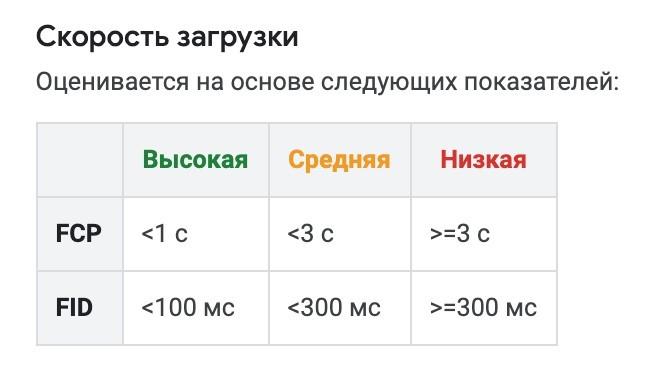
There are also other tools for checking and testing website speed. You may also find this article useful: How to find out the download speed: 14 services for analysis.
In November 2019, Google added the functionality of tracking the dynamics of website loading speed to Google Webmaster (instructions). Now you can track the speed in the console.
– Behavioral factors
Website promotion in Google is not only about optimizing the technical part, but also about working with the behavioral factors of the site. What factors are we talking about:
- Website click-through rate;
- The number of conversions from search;
- Satisfaction with the answer;
- Website traffic;
- Time on the site;
- Bounce rate;
- Browsing depth;
- Page scroll depth;
- Social interaction.
– Freshness of the publication
Google makes sure that users receive the latest information. How to rank your website in Google – take care of updating your website and content.
The Google Freshness update was a significant change in the ranking algorithm based on the Caffeine update that was released in June 2010.
Google evaluates the relevance and freshness of content on the entire site, takes into account the date of creation of the page, the frequency of content changes and their scale. Promotion on Google requires working with the relevance of your content. The relevance is not taken into account for all documents, for example, it does not apply to literary works.
– Text of anchors on linked pages
The promoted page should have anchor text from the internal links of the site. It is about organizing competent internal linking, with the help of which you can organize the correct “saturation” of the necessary pages with links within the site.
To do this, you need to use both automated solutions and manual contextual (semantic) linking.
– Location, number and spread of phrases on the page
To figure out how to raise your website in Google search, you need to understand how other projects have done it.
Use key phrases in different areas of the page, namely:
- in the SEO text
- title;
- H1;
- Text inserts (blocks);
- links (anchors);
For a detailed study of this block, you need to use specialized software or services:
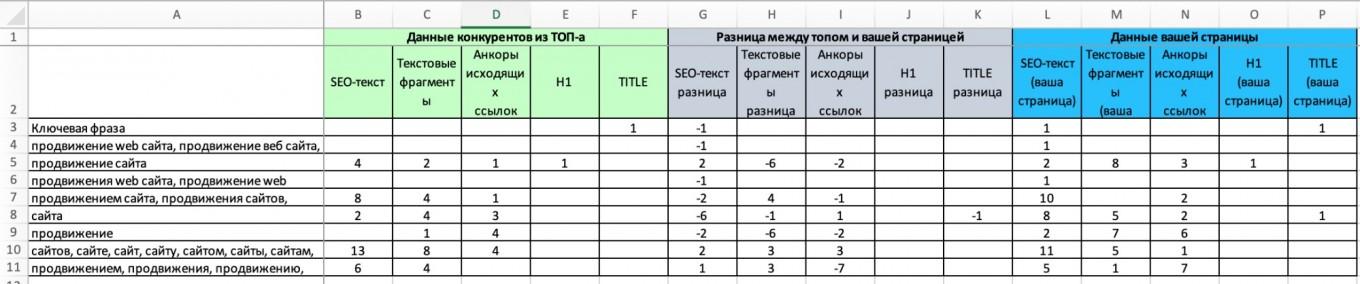
An example of how a text analyzer works
You can perform this analysis manually, but it will take a lot of time.
– The amount of content on the page
Google likes large texts, especially information queries (longreads). When preparing content for a landing page, you should take into account the average content volume of the documents in the top 10.
Often, you just need to analyze the results and create a page with a large amount of content. However, more is not always better. Therefore, we prepare material that will answer all the necessary questions of the user on the topic.
– Unique and relevant images
Unique images that match the content of the page increase the relevance of the query page. Involve specialists – a photographer, a designer – to prepare professional images for your website.
What’s more, thematic images will help you drive additional organic traffic from Google image searches.
Important: According to John Mueller, Google does not take into account images in CSS styles.
Use key phrases in the description of images in the ALT (page language) attribute of the image, as well as the name of the image file.
Google employee Gary Ilsch says that in order to optimize images on the site, you need to
- give the bot access to images in robots.txt;
- create a separate XML sitemap for images – this way the bot will find images faster;
- make sure that the content of the image corresponds to the text around it, the title and description of the page;
- use markup for pages.
Useful material: ALT and TITLE attributes: optimizing images, as well as Promotion and optimization of images: 8 mandatory steps
– Accessibility for people with disabilities
According to the position and initiative of Google:
We strive to make Google services and products easy and understandable for everyone. And people with disabilities shouldn’t experience any inconvenience. That’s why we take their interests into account throughout the development process.
The Google team is guided by the WCAG 2.0 document (which is being worked on by Senior Developer Loretta Guarino Reid and Developer Shawn Lauriat), namely 4 principles:
- Principle 1. Acceptability. Information and user interface components should be available to users in a way that they can perceive.
- Principle 2. Operability. User interface components and navigation should be operable.
- Principle 3. Comprehensibility. The information and operation of the user interface should be understandable.
- Principle 4. Reliability. The interface should be reliable enough to be interpreted by a wide range of user agents, including assistive technologies.
More details here: https://www.w3.org/TR/WCAG20/#robust
– Anchor text for internal links
Let’s not forget that we are talking about useful and relevant content. Anchor text (link text) should be relevant to the content of the page. Links should lead to documents/pages that are really useful and necessary for the user.
– Including the query in the URL
This refers to the use of a key phrase in the URL. It is worth noting that this factor is controversial according to SEO experts.
Moreover, in practice, there are many successful examples and cases without the use of keywords in the URL (at the same time, the influence of other factors should be taken into account).
Create correct and understandable CNCs, we have prepared instructions and recommendations on this topic: How to set up a CNC: everything you need to know about the right URL for SEO
– Site/brand mentions (without links)
Google picks up on brand and website name mentions even if there is no link.
So, if you are working on your project’s link profile and have not yet taken steps to increase the number of brand mentions, it’s time to finalize your strategy.
In 2018, John Mueller, in the video (see from mark 23.25):
https://www.youtube.com/watch?v=02Pahw9zyOA&feature=emb_logo
He emphasized that Google records a brand mention without a link, but it is not the same as a text link. PageRank is not transferred.
How to find brand mentions?
Method 1: Through search, use the combination (any query + social media exclusion/any other site):
“keyword/brand name/person’s name” -site.com -twitter.com -facebook.com -google.com”
Method 2. Google Alerts
– Age of the site
The factor of the site’s age is an old-timer. It is generally accepted that there is a period of “growing up” or “sandboxing” and if the site is new, roughly, you can use *2 terms of promotion. This is based on the experience of SEO specialists in promoting new sites on Google and the fact that in the period from 2 to 5-6 first months of a site’s life, it is poorly ranked or not ranked at all.
At the same time, if we talk about the age factor for non-green sites, its weight and influence is questionable, as a combination of quality content, links, and other factors allows older sites to be outranked.
This factor is also controversial in the above study of SEO experts’ opinions. But, one way or another, it can be noted that Google is “warmly” treating old sites with a history.
What is important to consider:
- About the age. John Mueller confirmed that the age of a domain does not affect the ranking results.
- About the paid period of the domain. Google’s patent states that the search engine perceives the domain date and trusts older domains more:
“Valuable legitimate domains are often paid for several years in advance, while illegal domains are rarely used for more than a year. The expiration date of a domain in the future can be used as a factor in predicting the legitimacy of the domain and, therefore, the documents associated with it.”
Useful material on the topic:
Promoting a young website: 10 mandatory steps
– How to use AMR
Google’s recommendations on AMR pages and how to promote AMR pages on your website.
– Outbound links
Many SEO specialists consider outbound links to be a negative factor. This is not the case. The presence of outbound links to trusted and useful sources for the user increases the relevance and value of the page content (according to MOZ research ), because the user receives additional useful data and details. Google takes into account not only the content itself, but also outbound links and their usefulness.
Useful: John Mueller explains this in this video.
– Key phrase in the domain name
It is an advantage to have a domain name that exactly matches the keyword phrase that the user entered in the search. The key phrase can increase click-through rates because it is easier to understand what the site is about by the domain.
However, this factor should not be overestimated, and here’s why..:
Until 2012, a low-quality site that contains a keyword phrase in its domain name could get high rankings for a query that is in the domain, but in 2012 Google released the EMD Update, according to which the influence of this factor has decreased.
Therefore, it can be emphasized that a low-quality website in combination with a domain with a keyword phrase may not give the desired effect and website promotion through Google will definitely fail if these are the only reference points. Make a high-quality website with the same content and use this advantage to the maximum.
4. 4 factors that affect SEO performance
– Contractor and client team
The minimum necessary conditions for a proper agency-client relationship are as follows:
On the part of the agency:
- Project manager;
- SEO specialist;
- Junior SEO specialist.
From the client’s side:
- A project manager who interacts with the agency. Prepares the necessary additional content, agrees on changes, approves the necessary blocks of information with the manager.
- Owner/manager – approves the strategy, coordinates implementations, and tracks project KPIs.
Specialists (can be on the client’s or agency’s side or connected from the outside):
- Programmer;
- Copywriter;
- Content manager.
If this combination is not available, there may be difficulties.
Why does the project team affect the result? 3 simple “ifs”:
- If the project is large, it is necessary to expand the team from the agency’s side: to connect additional junior SEOs or another SEO specialist to the project.
- If there is no programmer and no quick implementation of changes, the project will be delayed.
- If there is no client involvement in the project, the project will be delayed or not achieve results at all.
Also interesting and useful information from Google: recommendations for choosing an SEO contractor
– SEO budget
How does the budget affect the promotion results? Directly! This is important if you want to figure out how to get your website ranked on Google.
Useful article: We have prepared a detailed article on SEO pricing: How much does website promotion cost?
The higher the budget for an SEO project, the faster you can achieve results, and why:
- The higher the level of expertise of an agency or specialist, the higher the cost of work;
- The more time an SEO contractor invests in a project, the faster they can get results;
- Website promotion is not only the work of promotion specialists, but also the costs of the project: a programmer, writing texts, and content preparation. The higher the budget, the faster your contractor will be able to prepare the necessary material;
- The strategy of link placement may be different, but there is one fact: the quality and quantity of links affect the results. High-quality sites are more expensive.
– Initial technical condition of the website
One of the most important factors in the success of a project is its technical condition and capabilities. Optimizing a website for Google will definitely require technical changes on the site.
Of course, loading speed, etc. are key components, but where does it all start?
- CMS capabilities. The site is based on a self-written system or a common CMS.
- Available and necessary functionality. It can be a system of tag templates, filter pages, etc.
- Developer. To successfully promote a project, you need a developer who will implement SEO solutions and eliminate errors, if any.
– Readiness for changes
Website promotion in Google and other search engines is the work of 2 teams: the contractor’s team and the client’s team.
To get the maximum effect in promotion, you need full participation of the business in the process. What changes you need to be ready for:
- On the website. As a rule, improvements and changes are necessary. Implementation of new functionality, replacement of existing functions.
- In the content. There are 3 options:
- – content is prepared by an SEO contractor;
- – the SEO contractor forms a team of third-party contractors for the project;
- – the content is prepared by the client.
Regardless of the format, the client’s participation in the process is required. It can be about different materials for the site:
- videos
- price lists
- photos
- and other materials.
5. What free Google tools can be used
For effective promotion, Google itself offers a number of free tools to help SEOs.
| Title | How it will help |
| Google Trends | Analysis of the popularity and seasonality of search queries |
| Google Keyword Planner | Statistics on the popularity, competitiveness, and complexity of keywords |
| Google My Business | Local promotion |
| Google Search Console | Checking the site for errors and domain visibility in search results |
| Google Analytics | Collection and storage of analytical SEO data |
| PageSpeed Insights | Check download speed on mobile devices |
| Google Tag Manager | Track user activity |
| Looker Studio (past Google Data Studio) | Reports and visualization of website statistics |
| Google Structured Data Testing Tool | Rechecking the resultsThese are the basic and most popular tools among SEOs. |
6. Methods of website promotion on Google
You can promote your website on Google using different methods, depending on the specifics of your business.
– SEO in Google organic search
It is suitable for playing for the future, because a well-optimized page can stay in the top of the search results for a long time, generating targeted traffic and customers.
SEO is a systematic and constant work that requires regular investment. And since the result is visible in a few months, owners should be patient and continue to make efforts.
– Google Ads contextual advertising
The main advantages of PPC advertising are speed, predictability of results, and cost control. It is great both at the start, when it is important to gain the first traffic and make yourself known on Google, and as a constant marketing activity.
At the same time, the method works only at the moment when funds are invested. Therefore, analysis and competent optimization of campaigns are important.
– Local SEO in Google Maps
Promotion in Google Maps is a must-have for physical locations, but it is suitable for different business formats.
Competent filling out and maintaining a profile will help to attract target users quickly and without significant cash investments.
7. Website promotion in Google: what should you think about first?
If you have a new website, use this guide: Promoting a new website: 10 mandatory steps
First of all, you need to work on 4 main areas:
– Technical optimization of the site
If you have a new online store, you will find this guide useful: Promoting an online store: 16 mandatory steps. You can also use Google’s guide: Google’s Website Optimization Guidelines for Beginners. Technical optimization of a website in Google is one of the most important stages of promotion.
Checking website optimization in Google is primarily a matter of promotion timing. Mistakes can cost time. You can check the technical condition of the project yourself or order an SEO audit of the site.
– Competent semantic core
To create a semantic core on your own, you need to understand the tools: How to prepare a semantic core yourself
You can order the preparation of the semantic core for your project separately.
– Correct site structure
If you provide services, you may find our experience in updating a company’s corporate website useful: Case study on launching a new company website
– Competitor analytics and strategy
Almost every action of an SEO specialist, if it does not involve error correction, should be based on analytical data. When preparing the SoW for a text, we need analytics, when preparing a new structure, we need analytics, when preparing the semantic core, we need analytics, and so on.
Be sure to analyze competitors and formulate your strategy.
8. Prohibited methods of promotion on Google
According to Google’s guidelines, the prohibited methods are (or how to promote your site on Google and get into trouble)
- posting automatically generated content;
- participation in link exchange schemes;
- publishing pages with low-quality or copied content;
- masking;
- hidden redirects;
- placing hidden text or hidden links;
- use of dorways;
- publication of copied materials;
- participation in affiliate programs if you do not create content yourself;
- loading pages with irrelevant keywords;
- creating malicious pages for phishing and installing viruses, trojans or other unwanted software;
- misusing markup with structured data;
- sending automatic queries to Google.
If you are faced with the task of optimizing your website for Google, you must be familiar with this list.
9. Trends in website promotion on Google
We have divided the key trends into 2 blocks.
Areas you should focus on when promoting your website:
- Increase in the number of vertical search elements (maps, airline tickets, books, jobs, etc.)
- Voice search as a query input (i.e., the user speaks the query instead of entering it by hand).
- Voice responses similar to those offered by Google Assistant, Alexa, Sire, and others (i.e., the user receives the answer without using the screen).
- Zero-Click results in Google SERPs (queries that do not bring traffic to websites, and the answers to them are displayed directly in the SERPs).
- Google Discover and other products with recommendation feeds and suggested content.
Other trends that are important to consider:
- Progress in machine learning and artificial intelligence.
- The number and presentation of paid ads in Google search results.
- More vertical search elements in Google results (flights, hotels, jobs, events, books, Play, maps, etc.).
- Government interference in technology and the web environment. For example, European Union regulations, the General Data Protection Regulation (GDPR), Articles 11+13 on copyright protection, antitrust investigations against Google).
- Prohibition of cookies and obtaining data on visits and other user actions (due to changes related to privacy in browsers and government requirements).
- Improvements in visual search (new image recognition and search technologies).
- Government interference in Google’s activities related to the actions of the US Department of Justice and Congress. Antitrust plans of Bernie Sanders and Elizabeth Warren
Source: https://sparktoro.com/blog/resources/google-ranking-factors-2019/
10. Our cases of website promotion in Google
- Case study on the promotion of a cookware and tea store
- Promotion case – sale of windows
- Case study on promotion of an online store of industrial equipment
- Case study on promotion of a portal for new buildings
- Case study on promotion of a watch store
- Case study on promotion of an online watch store
- Service promotion case – ventilation maintenance
Other cases of our team can be found here.
11. Instead of a conclusion, here’s a brief summary of Google trends
Follow and study the updates that Google launches every year.
Once again, the key points of the article:
- Expertise. The role of expert content in ranking has increased. Study the Google Assessor’s Guide and work on your content’s expertise.
- Quality content that answers user questions.
- Links. Develop your project’s link profile.
- Mobile First Index. A convenient and fast mobile or adaptive version of the site is a must.
- Voice search is gaining momentum. Be the first to use it.
We hope you found this article useful. Leave your questions in the comments. If you have encountered problems in website promotion or want to figure out how to make your resource be the first in Google search, write to us and we will review your project. We have been professionally promoting websites on Google since 2008.

